

Research project “iPRIS”
Funding: The collaborative project Instrument for the intraoperative assessment of the primary stability of pedicle screws in bone (iPRIS) – subproject: Visual decision support for the intraoperative assessment of pedicle screw stability – is funded by the Federal Ministry of Research, Technology and Space through the KMU-innovativ funding initiative, within the Health Economy priority area of the Health Research Framework Programme, under grant number 13GW0824B.
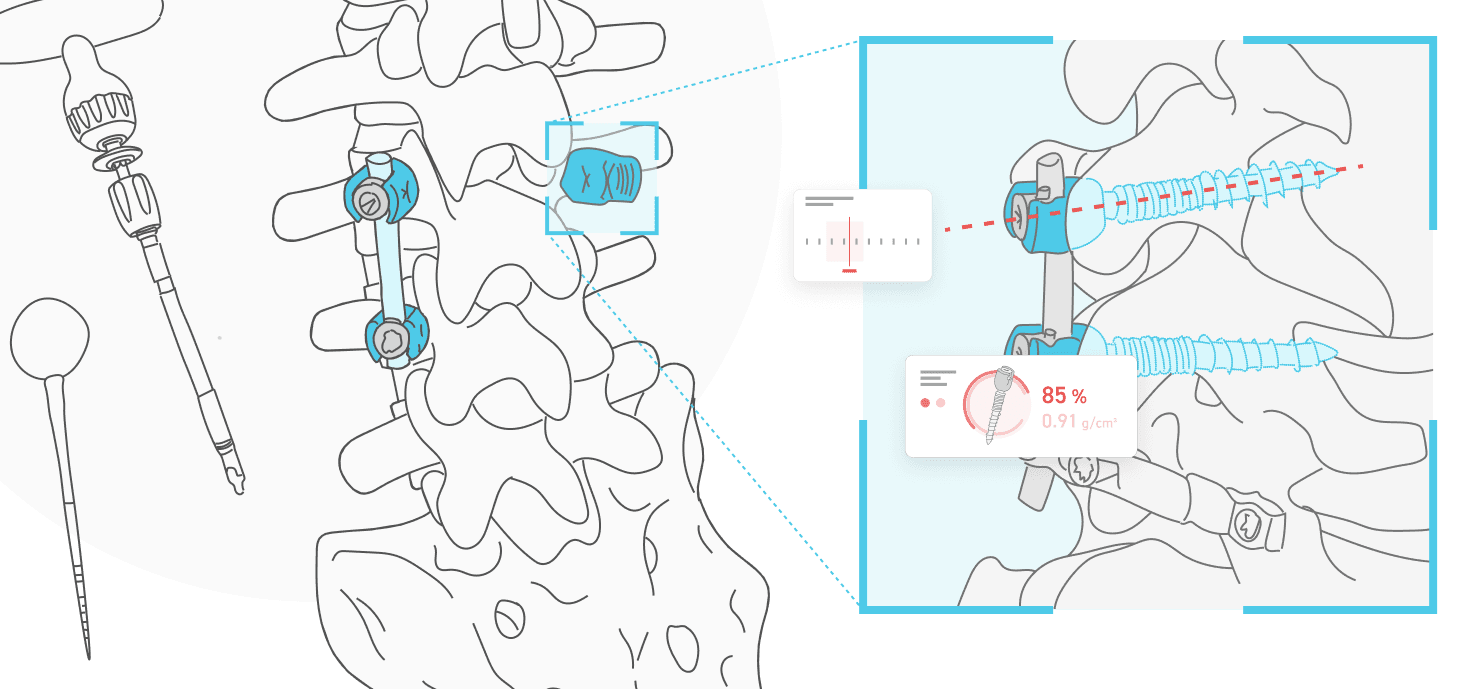
The iPRIS research project (Instrument for the intraoperative assessment of the primary stability of pedicle screws in bone) investigates how the stability of implants during spinal surgery can be objectively captured, analysed and communicated to surgeons.
The aim is to make a previously invisible, yet decision-relevant mechanical parameter available at the moment of surgery, thereby providing the basis for targeted support in the operating room.
Project partners
The project is funded by the Federal Ministry of Research, Technology and Space and is being carried out by a consortium of industry and research partners:
GTV – Gesellschaft für Technische Visualistik mbH
Software-based integration of Coupled Process Analysis (CPA) into a context-specific visual form that makes complex mechanical relationships immediately understandable during surgery.
Technische Universität Dresden, Faculty of Medicine Carl Gustav Carus
Practice-oriented definition of requirements and use cases for a clinical instrument intended for intraoperative use in spinal surgery.
Fraunhofer Institute for Machine Tools and Forming Technology IWU
Methodological investigation of the cause-and-effect relationships underlying the primary stability of pedicle screws in bone, based on vibration-based analyses.
endocon GmbH
Conceptual design and development of the intended surgical instrument.
SPEKTRA Schwingungstechnik und Akustik GmbH Dresden
Conceptual design of a sensor and actuator setup for the optimal extraction of relevant features from suitable sensor parameters.
Background
The iPRIS research project addresses a key challenge in spinal surgery:
At the decisive moment of surgery, the stability of an implant cannot yet be assessed objectively — even though it is crucial for the further course of treatment. Intraoperative assessments therefore often rely on preoperative examinations and the subjective experience of the surgeons, while the actual mechanical relationships within the bone remain invisible.
As a result, there is no reliable basis for objectifying the anchoring state of pedicle screws during the procedure and making this information usable in the surgical moment. Currently:
- no directly applicable measurement methods are available
- individual bone quality is difficult to assess
- critical relationships between material, structure and stability remain hidden
Consequences:
Because the anchoring of pedicle screws strongly depends on individual bone quality, there is an increased risk of complications such as loosening or insufficient stabilization. With the growing number of spinal surgeries, this uncertainty is becoming increasingly relevant — both for the quality of treatment and for the burden on the healthcare system.
Project objective
The objective of the project is to develop an instrument for spinal surgery that enables the intraoperative assessment of the primary stability of pedicle screws.
The instrument is intended to provide surgeons with direct and immediate feedback on anchoring stability in order to informed decision-making during the procedure.
In the iPRIS research project, this is to be achieved through a system that analyses the stability of pedicle screws during surgery using vibration measurements. The data obtained is evaluated using Coupled Process Analysis (CPA), and the results are communicated in a visually prepared form. The visualization is provided directly on the instrument and designed to be immediately understandable in the surgical context.
This enables surgeons to adapt their surgical approach based on the mechanical relationships made accessible by the system.
Expected results
The project aims to develop a functional prototype of an intraoperative instrument that:
- not only measures stability, but makes it interpretable
- reduces uncertainty in the decision-making process
- provides the basis for high-quality surgical outcomes
The results will form the foundation for further product development with the goal of clinical application.