

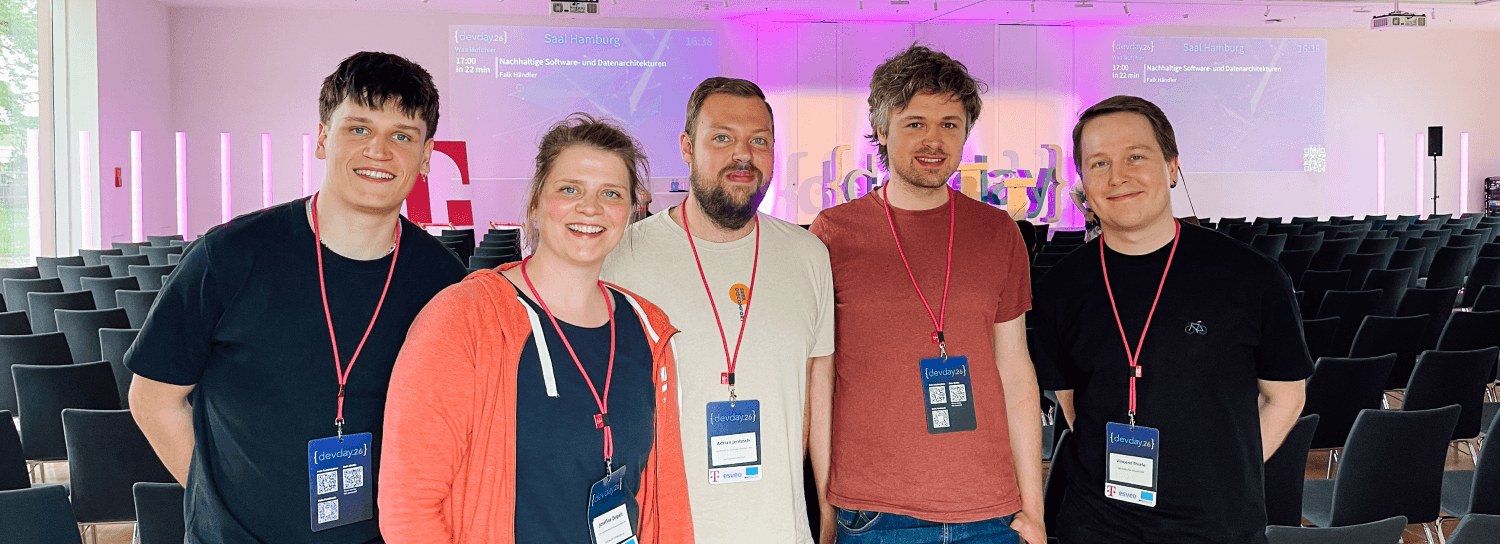
Dev Day 2026
It’s important for us to stay on top of the latest developments in our field and explore new perspectives. On May 5, Dev Day 2026 provided the perfect setting for this: Our team was there with a question that also occupies us in our own work:
How is AI changing the development process – and what tasks will remain for humans?
The workshop “AI can code – so what?” focused precisely on this shift.
Not on the question of whether AI will replace developers, but on how work changes as AI-powered tools become more integrated into everyday life. We were particularly interested in understanding how other teams are already using these tools today – and what insights this offers for future development.
Based on our observations, work is shifting in three areas that are noticeable in everyday practice:
Code reviews are becoming more important.
Even when AI generates code, developers remain responsible for the result. The focus is shifting: what matters is not just whether a solution works technically, but whether it fits the architecture, the business requirements, and the overall system.
Errors are becoming harder to detect.
AI-generated code may appear clean at first glance and pass tests. Nevertheless, the solution may fail to meet the actual business needs. This makes the deliberate alignment of requirements, context, and implementation increasingly important.
Mentoring is evolving.
Experienced developers don’t just pass on technical knowledge; above all, they provide context: Why was a particular solution chosen? What dependencies exist? Where is caution needed? At the same time, younger developers often bring a fresh perspective on new tools. Both of these elements help the team learn together.
Our conclusion:
AI is changing how digital solutions are created. But it does not replace an understanding of technical expertise, context, and the actual problem. Good solutions emerge where technology, technical expertise, and human understanding come together in a meaningful way.